
On this page
Fake or misrepresented oud usually takes one of four forms: a different wood dyed and fragranced to look like agarwood, low-grade agarwood dyed or injected to look like a high grade, synthetic fragrance or diluted oil sold as pure oud oil, and genuine agarwood with a false origin or wild claim. The warning signs are a premium claim at a low price, too-uniform colour, vague listing language and paperwork that does not match the goods.
- In one Kew study of suspected agarwood seized at the UK border, only about 58 percent of samples were genuine.
- Synthetic oud is a legitimate product. The problem is selling it as natural.
- No single check is enough. Combine price, seller detail, paperwork and testing.
Agarwood combines high value, grading by smell and appearance, and a fragmented supply chain running through many small sellers in many countries. That makes it unusually easy to misrepresent. Most buyers cannot verify a wild harvest claim, an exact origin or whether an oil is undiluted, which leaves plenty of room for sellers to overstate what they offer, deliberately or not.
This guide covers the warning signs you can spot before you buy. For checks you can run on a piece in your hand, see how to test agarwood authenticity at home.
Why fakes are common
Quality is judged largely by sensory evaluation, smell, weight and visible resin, rather than anything printed on a label. No single body checks individual listings. And demand for high-grade, wild-sourced material far exceeds what genuinely exists, given how scarce wild resinous trees have become, as covered in wild vs plantation agarwood. That gap is where misrepresentation lives.
There is hard evidence of the scale in at least one setting. Researchers at the Royal Botanic Gardens, Kew, examined 83 samples of suspected agarwood that UK Border Force had sent for identification. Roughly 58 percent were authentic. The rest were substitutes or adulterated material, including pinewood dyed and fragranced to mimic agarwood, plant corms from an unrelated family, and five samples that contained no plant material at all. These were suspect seizures rather than a random sample of the market, but they show what fakes actually look like.
The main kinds of fake
| Type | What it is | Main warning sign |
|---|---|---|
| Substitute | Another wood or material made to look like agarwood | Uniform colour, strong cold perfume |
| Upgraded wood | Low-resin agarwood dyed, coated or injected | Too even, too heavy for its look |
| Misdescribed oil | Synthetic, blended or diluted oil sold as pure oud | Low price for "pure," identical batches |
| False claims | Real agarwood with an invented origin, age or wild claim | Vague language, no paperwork |
Price: the signal to weigh most
Genuinely wild, resin-rich agarwood is scarce and expensive to source, and its price reflects that. A listing that describes wild or top-grade material at a price close to ordinary plantation wood is very unlikely to be what it claims. What realistic prices look like is covered in how much does agarwood cost.
Cheap is not the same as fake. Plantation agarwood at lower resin grades is genuinely inexpensive, and a seller pricing it honestly is not misrepresenting anything. The red flag is the combination: a premium claim, such as wild, top grade, rare species or great age, at a price that cannot support it.
Dyed, coated and injected wood
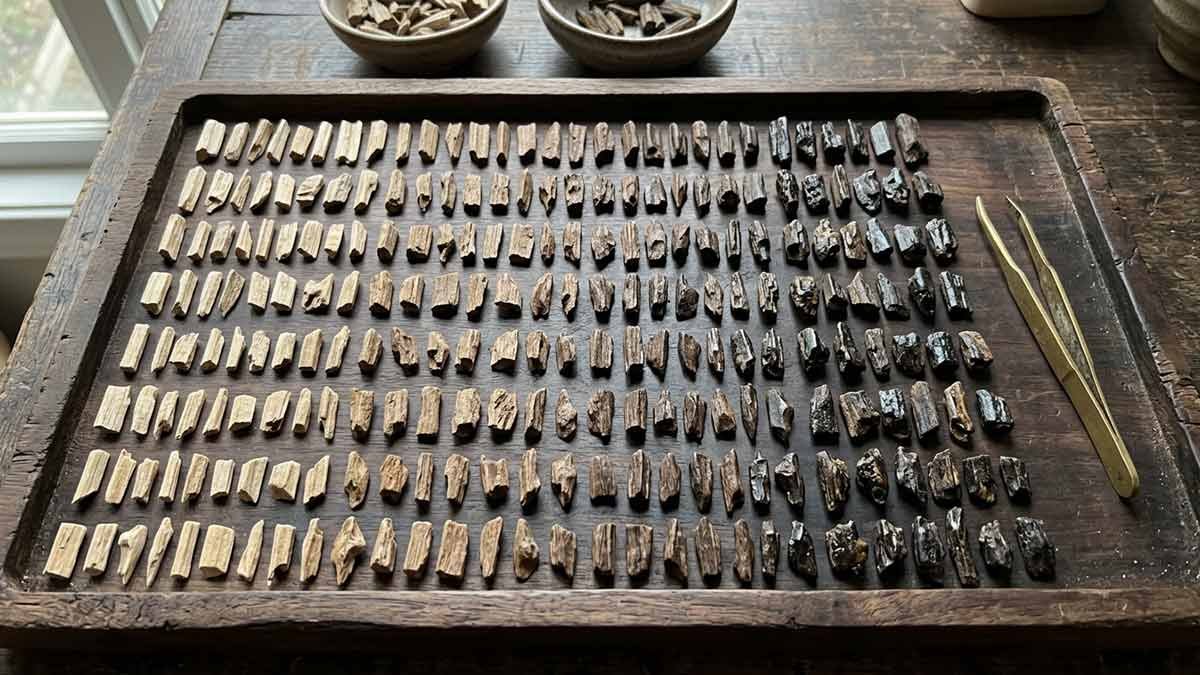
A common way to upgrade low-resin wood is to darken it with dye or coating, or to force oil into it under pressure, so that it looks and weighs like a higher grade. The visual giveaway is uniformity: an even black or dark brown over the whole piece, where real resin forms irregular streaks and patches through paler wood.
Want the visual, weight and smell checks for a piece in your hand?
Test agarwood at homeInjected wood can also feel unusually heavy, because the point of injection is to imitate the density of resinous wood. That is why a sinking test on its own is not conclusive, as explained in how agarwood is graded. Fragrance is the other common addition: Kew's substitutes had been fragranced as well as dyed, so a strong scent straight from the packet is a reason for more suspicion, not less.
Oil that is not what it says
Oil is harder to inspect than wood. Synthetic oud fragrances are a legitimate product category, widely used in perfumery, but they become a problem when sold as "100% pure" or "natural" oud oil. Genuine oud oil can also be stretched with carrier oils or blended with other materials and still sold as pure. Signs worth noticing include a low price for an oil labelled pure, a scent that is identical from batch to batch, and a seller who cannot say where or how the oil was distilled. Paper and viscosity checks are often recommended in the trade, but diluted or blended oils can pass them, so treat them as weak signals at best. The difference between the two products is covered in synthetic vs natural oud oil.
Listing language
Sellers with real sourcing knowledge tend to be specific: a species, a region, how the wood was grown or harvested, and what a grade name means to them. Listings that lean on phrases such as "ancient wild forest" or "rare hundred-year aged," with nothing checkable behind them, deserve more scrutiny. So do identical descriptions and photos repeated across many unrelated seller accounts, which often point to resold stock from a common wholesale source.
Paperwork that does not add up
All Aquilaria and Gyrinops species are listed in CITES Appendix II, so commercial international trade needs export permits, as covered in agarwood and CITES explained. Under CITES guidance on personal effects, a traveller can usually carry up to 1 kg of chips, 24 ml of oil and two sets of beads, prayer beads or bracelets without a permit, though individual countries can apply stricter rules.
A small personal purchase arriving without CITES paperwork is therefore normal. The red flags are commercial quantities of supposedly wild material with no permits at all, or documents that do not match the species, quantity or origin being sold.
Where fakes turn up most
Misrepresentation is not spread evenly. It appears more often at tourist stalls, where buyers have little time and no recourse; on large general marketplaces with minimal seller vetting; and from accounts with no sales history, no verifiable business details and stock photos instead of pictures of the actual piece. None of these makes a fake certain, but each makes one cheaper to attempt. See buying agarwood online vs in person and red flags when buying agarwood.
How we checked this. Figures on seized samples come from the Kew study below, and the CITES personal allowance from CITES guidance covered in our CITES guide. Where trade checks are unreliable, we say so.
Sources
- Grosskopf, E. K., Simmonds, M. S. J. and Wallis, C. J. (2023). Combining near-infrared (NIR) analysis and modelling as a fast and reliable method to determine the authenticity of agarwood (Aquilaria spp.). Analytica, 4(2), 18. Royal Botanic Gardens, Kew.