
On this page
Wild and plantation agarwood are the same material formed in different ways. Wild agarwood forms when a forest tree is injured and infected by chance, usually over many years. Plantation agarwood is induced on purpose by wounding cultivated trees and inoculating them, which is faster and more predictable. Wild material generally costs far more.
- Both rely on the tree's own defence response to wounding and infection.
- The view that wild agarwood smells better is widely held in the trade, but it is not a settled scientific finding.
- "Wild" is one of the most misused labels in agarwood marketing, and cannot be confirmed by eye.
Every piece of agarwood, wild or cultivated, forms through the same biology covered in how agarwood resin forms: a wound, colonisation by fungi or other microorganisms, and a resin response the tree produces to defend itself. Wild and plantation agarwood are not different substances. They are the same process happening under different conditions, on different timelines, with different levels of human control.
This guide sets out what distinguishes the two in practice, and is direct about which differences are well documented and which are closer to trade opinion.
| Wild | Plantation | |
|---|---|---|
| Trigger | Chance injury and natural infection | Deliberate wounding and inoculation |
| Timeline | Generally years to decades | Months to a few years after induction |
| Predictability | Low. Many trees contain little or none | Higher, though yield still varies by tree |
| Price | Generally far higher | Generally lower |
| Pressure on wild trees | High, historically including felling to search for resin | Low, since trees are grown for the purpose |
The core difference: chance vs deliberate wounding
Wild agarwood results from injury and infection that occur by chance during the natural life of a forest tree, with no human involvement in triggering the process. Plantation agarwood results from growers deliberately wounding cultivated trees and, in most modern operations, introducing selected fungal strains or other inducing agents to trigger the same resin response on a predictable schedule.
Nothing about this distinction makes one process more "natural" in a biological sense. Both rely on the tree's own defence response. The difference lies in how, when and how reliably that response is triggered.
How wild agarwood forms
In forest conditions, Aquilaria and Gyrinops trees are wounded by storms, lightning, insects, animals or people, and only some of those wounds go on to be colonised by the organisms that trigger resin formation. Because this depends on chance, only a minority of wild trees in a given forest are likely to contain commercially significant agarwood at any one time, and resin bearing wood is often concentrated in older trees that have had more years of exposure.
That scarcity is why wild harvesting has historically meant searching through large numbers of trees, often felling them, to find the small proportion that contain useful resin. The practice has placed severe pressure on wild Aquilaria populations across South and Southeast Asia.
How plantation agarwood is induced
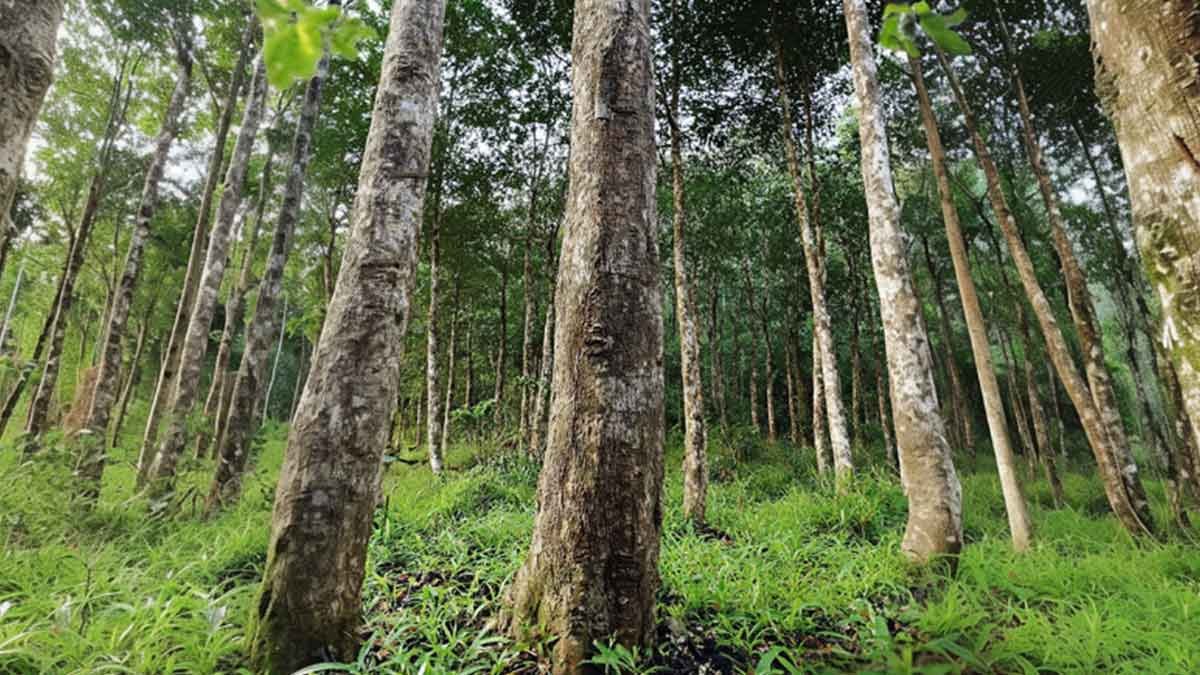
Plantation cultivation removes the element of chance by wounding trees and introducing an inducing agent, most often a cultured fungal strain such as Fusarium, directly into the wound. Methods range from drilling individual holes and filling them with inoculant to whole-tree techniques. One peer-reviewed study on cultivated Aquilaria sinensis described a whole-tree agarwood-inducing technique, in which an inducing agent is transfused through the trunk so that resin forms throughout the tree rather than only at a wound. It reported agarwood yields of 4 to 28 times those of the older methods it was compared with. The extract content of that agarwood was similar to the wild samples tested, although its sesquiterpene content was somewhat lower.
Want the full picture of what happens inside the wood either way?
How agarwood resin formsTimeframes compared
Wild agarwood formation is generally understood to take a long time, commonly discussed in terms of years to decades, partly because it depends on chance infection and partly because much wild material comes from older trees. Plantation agarwood can produce assessable resin considerably sooner. Research trials have evaluated induced resin at intervals such as six months, one year and two years after treatment, with resin content and quality continuing to develop the longer the wood is left before harvest.
That does not make plantation agarwood instant. Growers generally still wait one to several years after induction before harvesting, and claims of agarwood produced in a matter of weeks deserve considerable scepticism.
Does wild agarwood smell different?
Many collectors and traders describe wild agarwood as deeper, more complex or longer lasting than plantation material, and wild wood from older trees has historically commanded a substantial premium. This is a widely held view in the trade, but it is a qualitative judgement rather than a settled scientific finding, and it is not universally shared. Some researchers and producers argue that advanced induction techniques now produce resin comparable to wild agarwood in controlled trials.
Researchers have also used chromatography and other analytical methods to distinguish wild from cultivated agarwood chemically, which suggests measurable differences can exist between batches. Whether those differences translate consistently into a scent difference a buyer can rely on, across the wide range of regions, species and induction methods now on the market, remains a more open question than confident marketing on either side suggests.
Conservation pressure and why plantations exist
Decades of wild harvesting, often involving felling whole trees to search for resin, have put serious pressure on wild Aquilaria populations. Aquilaria malaccensis was the first agarwood species listed in CITES Appendix II, in force from 1995, and every Aquilaria and Gyrinops species was added at the 2004 CITES conference. Wild scarcity and trade regulation together are a central reason plantation cultivation has expanded across Indonesia, Vietnam, Malaysia and other producing countries. How CITES governs the trade is covered in agarwood and CITES explained.
What this means when you are buying
For most buyers, the practical question is not which process is superior but which claim about a specific piece can be trusted. "Wild" is one of the most commonly misused terms in agarwood marketing, partly because it carries a price premium and partly because there is no simple visual test a buyer can use to confirm it. Provenance, seller reputation and documentation matter far more than the label. See questions to ask before you buy oud and red flags when buying agarwood.
How we checked this. The whole-tree yield figures come from the peer-reviewed study listed below. Judgements about scent are labelled as trade opinion, because they are.
Sources
- Liu, Y. et al. (2013). Whole-tree agarwood-inducing technique: an efficient novel technique for producing high-quality agarwood in cultivated Aquilaria sinensis trees. Molecules, 18(3), 3086 to 3106.