
On this page
The main red flags when buying agarwood are: vague origin ("premium oud" with no country or source), a price far below comparable listings for the same claim, a strong perfume or alcohol smell straight from the packet, colour that is too even, extraordinary claims such as "100-year-old wood" with no evidence, and sellers who will not answer questions or show the actual piece. One flag may be innocent, but several together are a reason to walk away.
- Price is the signal to weigh most when paired with a premium claim.
- Natural agarwood shows irregular resin, not even colour.
- Ask before assuming the worst, but trust a pattern.
No single sign proves a listing is fraudulent. But seeing two or three of the signs below together is a solid reason to slow down, ask more questions or walk away. How misrepresented agarwood is actually made is covered in fake oud: what to look for.
| Red flag | Why it matters |
|---|---|
| No specific origin | Cannot be checked, and often hides mixed or misdescribed stock |
| Price far below similar claims | The most consistent sign of misrepresented or diluted material |
| Strong scent straight from the packet | Often added fragrance rather than natural resin |
| Even, glossy colour | Consistent with dye, coating or injection |
| "Ancient," "100 years," "rarest" | Easy to write, hard to prove |
| Stock photos, no answers | Little accountability for what arrives |
Vague origin claims
Listings that only say "premium agarwood" or "rare oud," with no country, region or wild or plantation source, are harder to verify and often go with misdescribed stock. Reputable sellers can usually name an origin and explain what that means for the material, as covered in Origins & Varieties. Missing detail is a gap, not just an oversight.
A price too low for the claim
Good agarwood is scarce and expensive to source, as covered in how much does agarwood cost. A listing that claims something premium, such as sinking-grade chips, wild wood or "100% pure" oil, at a price far below comparable listings is one of the most consistent signs of misrepresented or diluted material. Cheap is not a red flag by itself: plantation agarwood is genuinely inexpensive. The problem is the mismatch between claim and price.
Want documented price reference points?
How much does agarwood cost?Added scent
Low-grade wood and substitutes are often sprayed or soaked with fragrance to imitate agarwood. Researchers at the Royal Botanic Gardens, Kew, found pinewood that had been dyed and fragranced among suspected agarwood seized at the UK border. Added scent tends to be loud straight from the packet, sometimes with a sweet, chemical or alcohol edge, and fades within days or weeks. Genuine agarwood usually smells faint when cold and comes alive when gently warmed.
Suspiciously uniform appearance
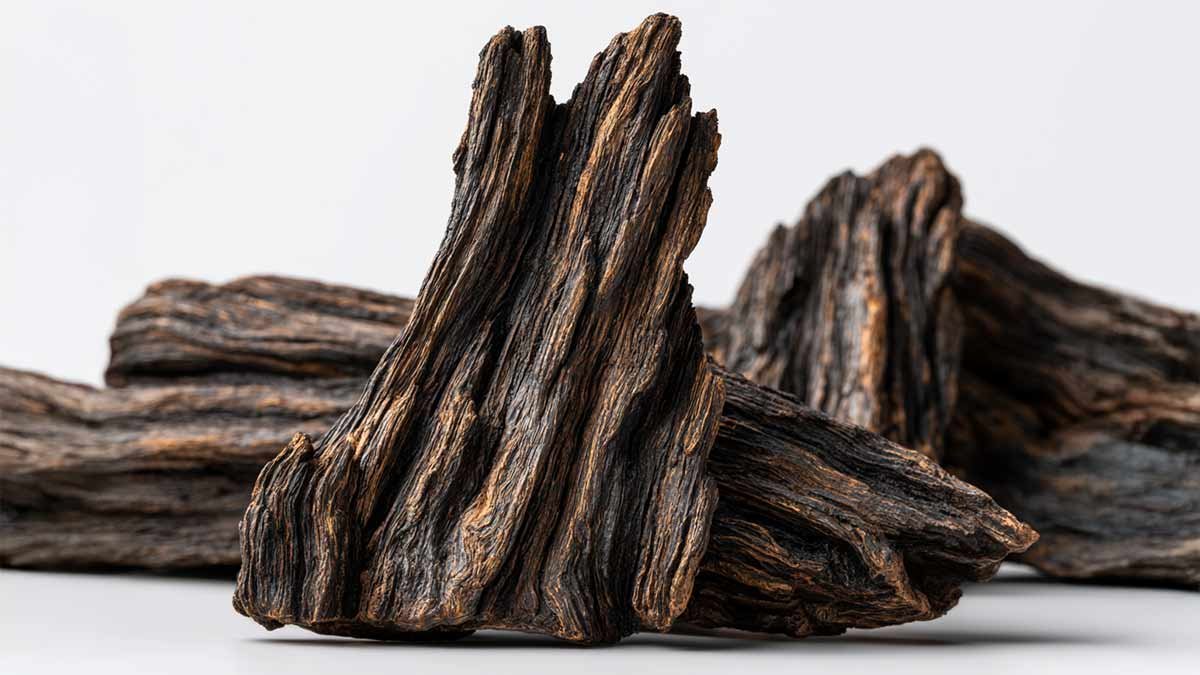
Real agarwood, whether chips or beads, shows natural variation: dark resin streaks and patches through paler wood, visible grain and small irregularities. Pieces that are evenly black or brown all over, unusually glossy, or identical to one another are more consistent with dyed, coated or injected wood. Pressed beads made from powder can also look very even, which is fine if they are sold as pressed.
Big claims, no evidence
"Hundred-year-old wood," "extremely rare kynam" or "wild Hindi oud" are easy to write and hard to verify. The more extraordinary the claim, the more evidence it deserves: photos of the actual piece, a clear account of where it came from, documentation, a seller history, or independent reviews. Kynam claims in particular attract misrepresentation, as covered in Vietnamese agarwood grading.
Seller and listing signs
Watch for stock photos instead of pictures of the item for sale, identical descriptions copied across many seller accounts, no verifiable business details or sales history, refusal to answer questions, and pressure to buy quickly. For commercial quantities of supposedly wild material, missing or mismatched CITES paperwork is a serious flag, as covered in agarwood and CITES explained.
What to do if you spot these
One red flag may have an innocent explanation, so ask the seller about it directly, using questions to ask before you buy oud. Several together are a strong reason to walk away. If you have already bought, the checks in how to test agarwood at home can help you decide whether to raise it with the seller or your payment provider.
How we checked this. The dyed and fragranced substitute example comes from the Kew study below. We corrected the draft's description of the directory, which records supplier claims rather than vetting sellers.
Sources
- Grosskopf, E. K., Simmonds, M. S. J. and Wallis, C. J. (2023). Combining near-infrared (NIR) analysis and modelling as a fast and reliable method to determine the authenticity of agarwood. Analytica, 4(2), 18.