
On this page
Cambodian agarwood comes mainly from Aquilaria crassna, the same species behind most Vietnamese and Laotian agarwood. Its historic wild heartland is the Cardamom Mountains in the southwest. Wild trees there are now scarce, the species is listed as Critically Endangered, and most Cambodian agarwood in trade today is grown on plantations.
- A recent field survey found at most about three native agarwood trees per hectare, even in the best sites.
- Both Aquilaria crassna and Aquilaria malaccensis are native to the Cardamom region.
- A "Cambodian" label describes a place and species, not whether the wood is wild.
Cambodian oud is one of the most recognised origin names in the agarwood trade, and it is often described by enthusiasts as one of the more sought after profiles in oud oil. The forests that built that reputation, however, now hold very few agarwood trees. Decades of harvesting have left wild populations thin, and the Cambodian agarwood reaching the market today comes largely from cultivated trees.
This guide covers what is documented about the species, the region, its conservation status and the restoration work now under way. For the scent side of the story, keep in mind that descriptions of a "Cambodian profile" are trade and collector opinion rather than a measured standard.
The species behind Cambodian oud
Most Cambodian agarwood comes from Aquilaria crassna, the main agarwood species of mainland Southeast Asia and the same species covered from the other side of the border in Vietnamese agarwood and Laotian agarwood. A second species, Aquilaria malaccensis, also occurs in the Cardamom region. Both produce resin through the wound-and-infection process described in how agarwood resin forms.
Because the same species grows across Cambodia, Vietnam, Laos and Thailand, the border on its own tells you less than the name suggests. Where the tree grew, how old it was and how the resin formed matter more to the finished material than which country's name is on the label. The genus background is in Aquilaria vs Gyrinops.
The Cardamom Mountains: Cambodia's agarwood heartland
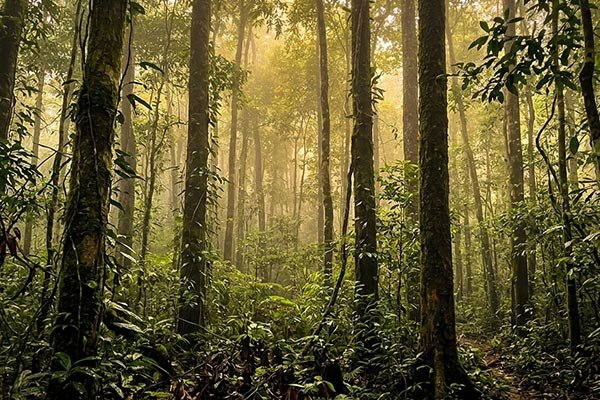
The Cardamom Mountains, the forested range in Cambodia's southwest, are the historic centre of the country's wild agarwood. The region spans four provinces: Pursat, Battambang, Kampong Speu and Koh Kong. Most of the wild agarwood trees that remain are reported to be in deep forest inside protected areas, with some regrowth in community forests and native trees also planted on village farmland as small family plantations.
| Province | Native trees per hectare |
|---|---|
| Koh Kong | Up to three in some locations |
| Pursat | About two on average |
| Battambang | About one |
How scarce wild trees really are
A field inventory carried out for a restoration project in the Cardamoms, across 176 survey plots, gives a clear picture of what is left. Koh Kong had the highest density, at up to three native agarwood trees per hectare in some locations. Pursat averaged about two, and Battambang about one. Most trees found were young, with trunks under five centimetres across, and of the 20 parent trees registered as seed sources, 17 were in Koh Kong.
Those numbers matter for buyers. Even in the best surveyed sites, wild agarwood trees are a small minority of the forest, most are too young to hold mature resin, and only some of any wild tree population forms resin at all, a point covered in wild vs plantation agarwood.
Curious how Cambodia's neighbour handles the same species?
Vietnamese agarwoodConservation status
Aquilaria crassna is listed as Critically Endangered on the IUCN Red List, in an assessment published in 2018. Aquilaria malaccensis, the region's second native species, carries the same status. Internationally, A. crassna came under CITES Appendix II when every Aquilaria species was listed at the 2004 CITES conference, so commercial export needs permits. The framework is covered in agarwood and CITES explained.
From forest to plantation
Long harvesting, often by felling trees in the search for resin, depleted Cambodia's wild agarwood, and the industry has shifted toward cultivated trees in plantations and family plots. On cultivated A. crassna, the restoration project described below reports that trees are typically inoculated at about eight years old, with resin then forming over roughly three years.
One detail is easy to miss. The same project notes that most plantations in Cambodia and Laos are reported to rely on seed sourced from Thailand, with little or no checking of species identity. In other words, "Cambodian plantation agarwood" may be grown in Cambodia from trees whose exact origin is not well documented. That is not a reason to avoid it, but it is a reason to treat species claims as claims.
Restoring native agarwood in the Cardamoms
Restoration work is now targeting the region directly. A project supported by the Asian Forest Cooperation Organization (AFoCO), run with Cambodia's Forestry Administration from 2023 to 2026, is restoring native A. crassna and A. malaccensis across the four Cardamom provinces with community forests, private plantation owners and seed collectors. By mid 2025 it reported more than 50,000 seedlings planted across about 35 hectares, and training for 164 local people.
Cambodian agarwood in the market today
For buyers, Cambodian agarwood today is in practice mostly plantation-grown Aquilaria crassna. Claims of wild "Cardamom" or "Koh Kong" wood deserve close scrutiny, given how few mature wild trees the survey work found and the species' protected status. As with every origin in this hub, documentation from the seller matters more than the regional name. See questions to ask before you buy oud and fake oud: what to look for.
How we checked this. Survey figures, project details and the seed sourcing note come from AFoCO's published project report, listed below. Descriptions of a Cambodian scent profile are presented as collector opinion.
Sources
- Asian Forest Cooperation Organization. Reviving native agarwood in Cambodia's Cardamom Mountains (project AFoCO/038/2023).