
On this page
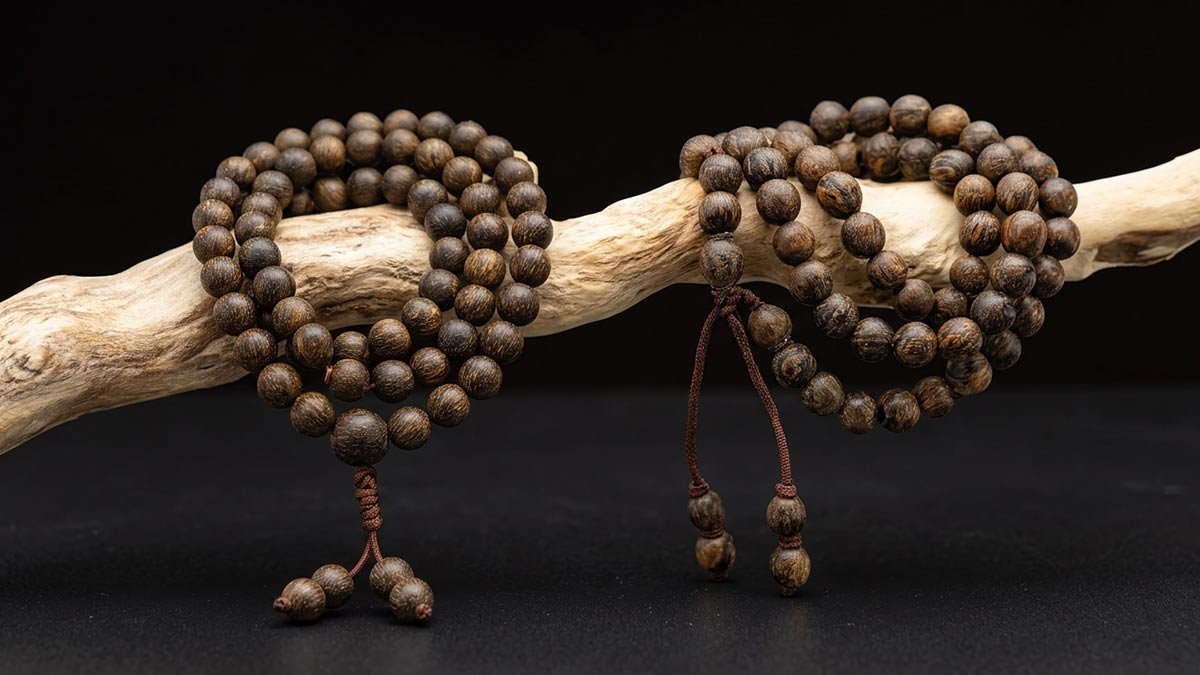
Agarwood beads are strung as Buddhist malas, traditionally of 108 beads, Islamic tasbih of 33 or 99 beads, and shorter bracelets. Good beads usually feel heavy for their size, show natural, uneven resin patterns and smell faint but genuine, especially when warmed by the skin. Uniform colour, a strong perfume smell straight from the box, or a scent that fades fast suggest dyed or oil-treated beads.
- Some beads are pressed from agarwood powder and binder rather than carved from solid wood.
- Agarwood beads are not exempt from CITES rules, though travellers have a personal allowance.
- Keep beads dry and away from perfume.
Agarwood beads offer a different way to experience the wood: not warmed for room scent, not distilled into oil, but worn against the skin. Strands range from simple bracelets to full devotional malas and tasbih, and the same material is valued for both its scent and its meaning.
Why agarwood for beads
Agarwood has long held spiritual associations across the traditions covered in agarwood in Buddhism, agarwood in Islam and Hindu tradition, which made it a natural choice for prayer and meditation beads. Its scent is part of the appeal: beads worn against the skin release a faint, warm fragrance as they are handled and warmed.
Malas, tasbih and bead counts
A full Buddhist mala traditionally has 108 beads, used to count recitations of a mantra. Shorter wrist malas are common, often of 18, 21 or 27 beads, among other counts. An Islamic tasbih, also called misbaha, is commonly strung with 33 or 99 beads, used to count phrases of dhikr, the remembrance of God, with 99 often associated with the names of God. Everyday bracelets follow no fixed count and are simply sized to fit the wrist.
| Strand | Common bead count | Use |
|---|---|---|
| Buddhist mala | 108 | Counting mantra recitations |
| Wrist mala | Often 18, 21 or 27 | Everyday wear and practice |
| Tasbih or misbaha | 33 or 99 | Counting dhikr |
| Bracelet | Varies | Everyday wear |
Want the deeper history of agarwood in Buddhist practice?
Agarwood in BuddhismWhat good beads look and feel like
Resinous agarwood beads tend to feel heavy for their size, since resin is denser than plain wood, as covered in agarwood resin content. Look for natural variation: dark resin streaks and patches running through paler wood, different from bead to bead, rather than an even, dyed colour. Genuine beads usually smell faint at room temperature and more noticeable when warmed in the hand, rather than strongly perfumed straight from the box. Over months of wear, many owners notice their beads darken and develop a sheen.
Dyed, injected and pressed beads
Beads are a common target for misrepresentation. Plain or low-resin wood can be dyed to look resinous, or soaked or injected with oil or fragrance to imitate the scent and weight of good agarwood. Such beads often look suspiciously uniform, smell strongly at first, and fade quickly as the added scent wears off. Some beads are pressed from agarwood powder mixed with a binder, which can be sold honestly as pressed beads but should not be passed off as carved from solid wood. The warning signs in fake oud: what to look for apply here, and the checks in how to test agarwood at home, especially weight and the warm water check, work well on a single loose bead.
Beads and CITES
Unlike some finished agarwood products, beads and prayer beads are not exempt from CITES controls, so commercial international trade in them needs permits, as covered in agarwood and CITES explained. Under CITES guidance on personal effects, a traveller can usually carry up to two sets of beads, prayer beads or bracelets without a permit, though individual countries can apply stricter rules, so check before you travel with several strands.
Caring for beads
Keep beads away from water, soap and perfume, which can mark the wood and alter its scent, and take them off before washing, bathing or swimming. Avoid long periods in direct sun or high heat. Wipe them occasionally with a soft dry cloth rather than any cleaning product, and store them in a cloth pouch away from strong smells, as covered in how to store agarwood.
Buying tips
Buy from sellers who can tell you the wood's origin, whether beads are carved or pressed, and whether they have been treated with oil or dye. Price is a rough but real signal: heavily resinous beads cost far more than plain or lightly scented wood, so a cheap strand claiming high resin deserves scrutiny. See buying agarwood beads and questions to ask before you buy oud.
How we checked this. Bead counts reflect common religious practice, and the CITES position follows the CITES guidance covered in our CITES guide. Descriptions of how good beads look and age are presented as common experience.