
Synthetic oud is a legitimate, widely used category in modern perfumery, not an inherently fraudulent product. The problem covered elsewhere in this hub, in our guide to fake oud, what to look for, is specifically when synthetic oil is sold as natural without disclosure. Understood on its own terms, synthetic oud is worth knowing about simply because it's chemically a different thing from natural agarwood oil, not a cheaper version of the same thing.
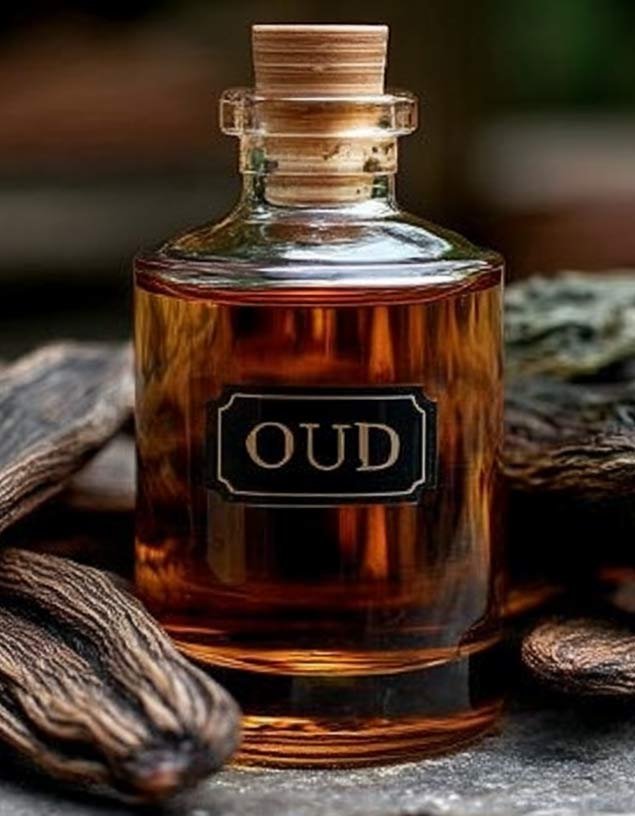
Different Products, Not Different Grades
It's tempting to think of synthetic oud as sitting at the bottom of the same quality scale as natural oud, a "low grade" rather than a different category. Chemically, that framing doesn't hold up. Natural oud oil and synthetic oud fragrance are built from substantially different molecules, pursuing the same general scent impression through entirely different chemistry. Major fragrance houses use synthetic oud deliberately and openly in named perfumes, which is a legitimate creative and commercial choice, not a deception, as long as it's disclosed as what it is.
What's Actually in Natural Oud Oil
Natural agarwood oil is genuinely complex. Analyses have identified more than 360 distinct chemical compounds within it, split roughly 56 percent sesquiterpenes and 44 percent chromones, the same broad split covered in our guide to how agarwood resin forms. The two compound families behave differently on skin: sesquiterpenes, with molecular weights around 200 to 222, evaporate over roughly 6 to 18 hours and carry much of the oil's early character, while chromones, heavier at roughly 250 to 400 in molecular weight, have much lower vapor pressure and linger far longer, contributing to the slow-developing depth oud is known for.
Why Sesquiterpenes Aren't Actually Replicated
This complexity is precisely why synthetic oud isn't a lab-made copy of agarwood's actual molecules. The sesquiterpene structures responsible for much of natural oud's characteristic scent are structurally intricate, and synthesizing them molecule-for-molecule would be prohibitively expensive at any commercial scale. Rather than attempting that, fragrance chemists engineer an entirely different set of aromachemicals designed to approximate the overall scent impression, not to recreate the original compounds.
Curious how resin chemistry develops in the first place?
How Agarwood Resin FormsWhat Synthetic Oud Actually Contains
Major fragrance ingredient houses produce specific, named synthetic oud molecules sold and used openly within the industry. Firmenich's Oud Synthetic 10760E is one such ingredient, used in niche releases including Le Labo's Oud 27. Givaudan produces a synthetic oud-replicating molecule marketed as Black Agar, built to recreate agarwood's warm, smoky character. Newer ingredients, including Firmenich's Oud Fireco and Agarwood Fireco, represent further refinements on these earlier synthetic oud molecules. These are used both as standalone substitutes in budget-friendly fragrances and, in some cases, to extend or stretch genuine natural oud in commercial perfumery.
The Price Gap, and What It Reflects
The price difference between the two categories is substantial. Natural oud oil commonly ranges from roughly $3,000 to $80,000 per kilogram depending on origin, grade, and rarity, while synthetic oud ingredients typically run from around $100 to $500 per kilogram, a gap on the order of 100 to 400 times. That gap reflects genuine underlying realities: natural oud depends on scarce, slow-accumulating resin and labor-intensive extraction, covered in our guides to resin content and distillation methods, while synthetic aromachemicals are manufactured at industrial chemical scale. The deeper breakdown of what specifically drives natural oud's price variation is covered in our guide to why oud oil prices vary so much.
Telling Them Apart Without a Lab
A few practical signals help, though none are absolute. Natural oud varies meaningfully between batches, shaped by origin, species, and even soaking time during distillation, while synthetic oud is engineered for consistency and tends to perform identically bottle to bottle. On skin, natural oud is widely described as evolving over many hours as its sesquiterpene and chromone content fade at different rates, while single-molecule synthetic approximations often read as comparatively flat and one-dimensional over the same period. The viscosity and paper-absorption checks covered in our fake oud guide apply here too. None of these checks are conclusive on their own; GC-MS chemical analysis remains the only way to confirm composition with certainty.