
On this page
In the Gulf, oud is first sorted by type: dehn al oud, meaning oud oil, versus mukhallat, a blended perfume oil. Origin names such as Hindi (Indian) and Cambodi (Cambodian) then act as shorthand for scent style and quality, and each attar house adds its own grade codes. None of these labels is standardised, and "dehn al oud" is also used in the names of blended products.
- Mukhallat means "mixed," a blend of oud with other materials such as rose, amber or musk.
- Hindi and Cambodi describe different scent styles, not a single quality ladder.
- "First fraction" and seller grade codes are trade terms, not verified standards.
The Gulf states are among the largest markets in the world for oud oil and agarwood, and they have their own way of describing quality. Rather than sinking grades or colour scales, Gulf retail leans on product type, origin names and house grade codes. Much of this vocabulary sounds technical but works as trade convention, so it helps to know what each layer does and does not tell you.
Dehn al oud and mukhallat
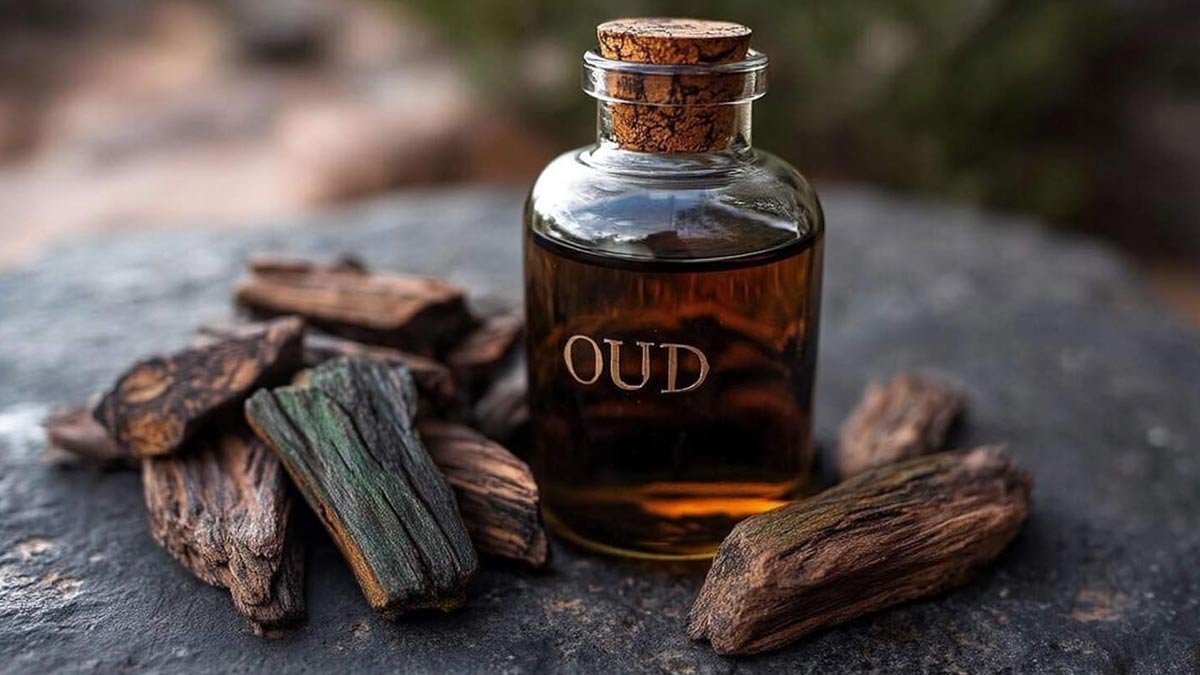
The most basic distinction in Gulf retail is between dehn al oud and mukhallat. Dehn al oud, from the Arabic for "oil of oud," refers to oud oil itself, distilled from agarwood. Mukhallat, meaning "mixed," is a blended perfume oil in which oud is combined with other materials, commonly rose, amber, musk, saffron or sandalwood. A mukhallat is judged as a composed perfume. Oud oil is judged as a raw material.
There is a catch. "Dehn al oud" is also used in the names of commercial products, including blended perfume oils and even sprays, so the phrase on a label does not by itself mean the bottle holds undiluted oud oil. What matters is whether the seller states that the oil is pure and undiluted, and whether they can say where and how it was distilled.
| Dehn al oud | Mukhallat | |
|---|---|---|
| Meaning | Oud oil | "Mixed," a blend |
| Contents | Oil distilled from agarwood | Oud with rose, amber, musk and other materials |
| Judged as | A raw material | A finished perfume |
| Watch for | The term used in blended product names | How much real oud, if any, is in the blend |
Origin names as grades
In Gulf trade, origin names work partly as grade and style indicators in their own right. "Hindi" oud refers to oil from India, associated mainly with Assam and the northeast, covered in Indian agarwood. "Cambodi" refers to Cambodian oil from Aquilaria crassna, and in retail the name is often stretched to cover similar oils from elsewhere in Indochina. Other names, such as Burmese, Malaysian, Indonesian or "Borneo" oils, fill out the vocabulary.
Because the same species grows across several borders, and because wood and oil move between countries before sale, an origin name on a label is a claim about style and source rather than proof of either. The geography behind these names is covered in the regional agarwood comparison.
Want the species and geography behind these origin names?
Regional comparisonThe profiles behind the names
Hindi oud is widely described by Gulf buyers and collectors as strong, smoky and animalic, sometimes called "barnyard," and is regarded by many as the classic reference for Gulf oud. Cambodi oud is often described as sweeter and fruitier, with notes compared to plum or dried fruit, and is considered by many to be more approachable for newcomers. These are trade and collector descriptions rather than measurements, and distillation choices, such as how long the wood is soaked, shape the result as much as origin does, as covered in oud oil distillation methods.
"Fraction" claims
Some listings describe oud oil as "first fraction" or "second fraction," borrowing language from fractional distillation. In retail use, the term often just refers to oil drawn earlier or later from the same distillation, and a buyer usually has no way to confirm what, if anything, was separated. Oil collected at different stages of a long distillation can differ, so the idea is not baseless, but treat a fraction label as a seller's description rather than a standard.
Seller grade codes
On top of type and origin, individual attar houses use their own letter grades, names and batch codes. A "Cambodi Grade A" from one house is not guaranteed to follow the same criteria as a "Cambodi Grade A" from another. These codes rank a seller's own stock, so a house's consistency over time is a better guide than the code itself. Oils are commonly sold by the tola, about 12 ml, and prices range from modest to very high for rare aged or wild-sourced oils, as covered in why oud oil prices vary.
What regulation covers, and what it does not
General fragrance and cosmetic rules apply to oud products sold in the Gulf, including industry safety standards such as those of the International Fragrance Association (IFRA) and regional cosmetic and labelling requirements. These cover safety and labelling, not origin, fraction or grade claims. A product can meet every safety rule and still carry an origin or grade claim no one has verified.
Reading a Gulf oud label
Start with the type: is this pure oil or a blend? Then the origin name: is it a specific claim the seller can explain, or a style label? Then the grade code: what does it mean within this house's range? For pure oil, ask where it was distilled, from what wood and by what method. See buying oud oil and synthetic vs natural oud oil.
How we checked this. Term meanings reflect standard Arabic usage, and scent descriptions are presented as collector and trade opinion. We removed a claim that the Gulf is the single largest market and claims about specific certification bodies we could not confirm.